I had agreed to meet Diana in Quito before we headed off for my last 2 weeks in Ecuador. Diana didn’t have long either and was on limited funds for her trip. Her brother owned Pacifico Hostel in Colombia where I had volunteered for a month and a bit the previous year. Diana was in Ecuador to publicise the hostel to the backpackers who were heading north and into Colombia next. For Diana it meant talking to hostel owners and trying to make an agreement where they would help each other out. For me it meant just chatting to people like normal and if they were heading to Colombia, I would give them a free night’s stay in the Pacifico Hostel.
Diana was also here on holiday being a tourist so before we left Quito and headed south, we had to take a trip to the Equator, the centre of the Earth. There is a place in Quito called ‘Mitad del Mundo’ (middle of the world) where you can visit museums and monuments. In 1736, Frenchman Charles-Marie de La Comdamine led an expedition taking measurements for around 10 years. They proved that the world wasn’t round and also found the equator. In 1936, the Ecuadorian government built a monument on this sight to recognise 200 years since the French effort and in 1979 this was replaced by the current 30 metre tower supporting a globe with a 5 foot diameter. You also have the painted yellow line on the floor which marks the Equator.
Now I don’t know whether the French had a bottle of wine for breakfast every morning throughout those 10 years but they got it wrong. The actual equatorial line lies a quarter mile north and has been proven by high tech GPS machinery. Yet still half a million people a year visit Mitad del Mundo oblivious to the fact they are 240m, or a short walk, from the actual equator. The real line can be found in a different attraction called the Intiñan Solar Museum, a private place with experiments and a brief history of Ecuador and the Equator.
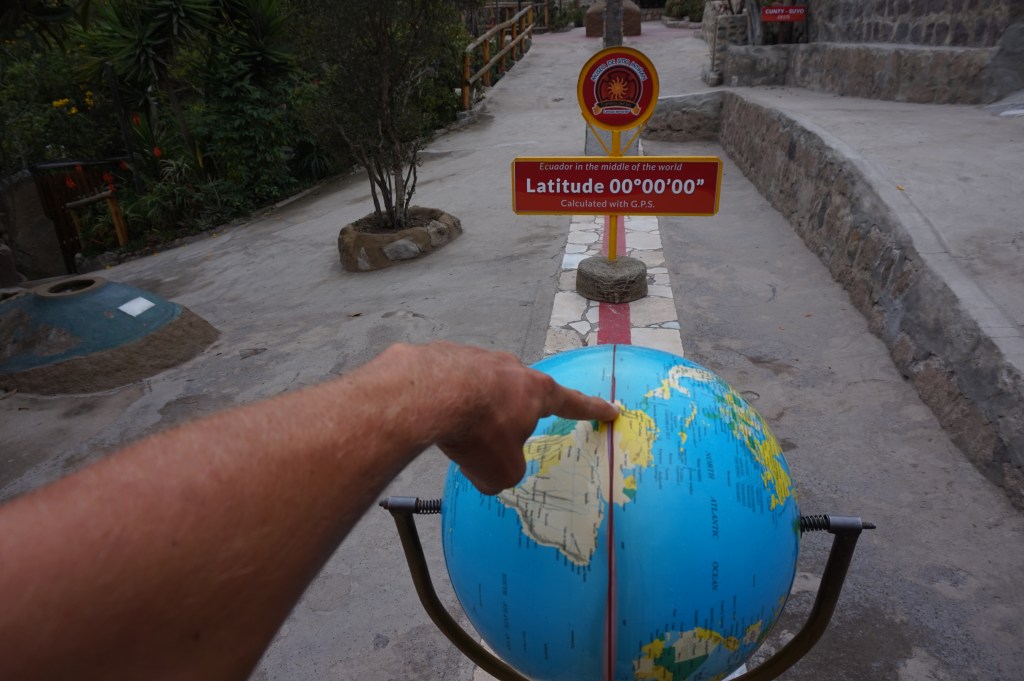
We decided to go to the real equator and this was accessible by bus from the centre of Quito. Entrance was a minimal fee and included a guide taking us around different things to see about the history of the equator and the other stuff it involves. There were experiments like balancing an egg on a nail (for which I got a certificate) and walking along a line (which was very hard to do). Due to the forces of nature, these were both hard to achieve supposedly down to the fact that you were stood on the centre of the earth. There was also the experiment that shows the water going down the plughole in different directions on the different sides of the equator. For an hour it was good fun and interesting to see and learn some stuff.
Upon leaving, I checked my GPS position on my map app and it told me that the centre of the world was in fact a damaged drainage gutter full of rubbish on the side of the road. Obviously my app isn’t as high tech as the machinery used to get an accurate positioning of the equator but I just wanted a picture with the reading of 0´s on my phone. Even that was impossible so we got the bus back to Quito to prepare ourselves for the journey to Baños the following day. Baños is a tourist favourite place that has plenty to see and do whilst set in a beautiful location surrounded by mountains and cliffs. A short bus ride from Quito meant we arrived at Baños in the afternoon and had a little time to walk around and plan what we wanted to do.
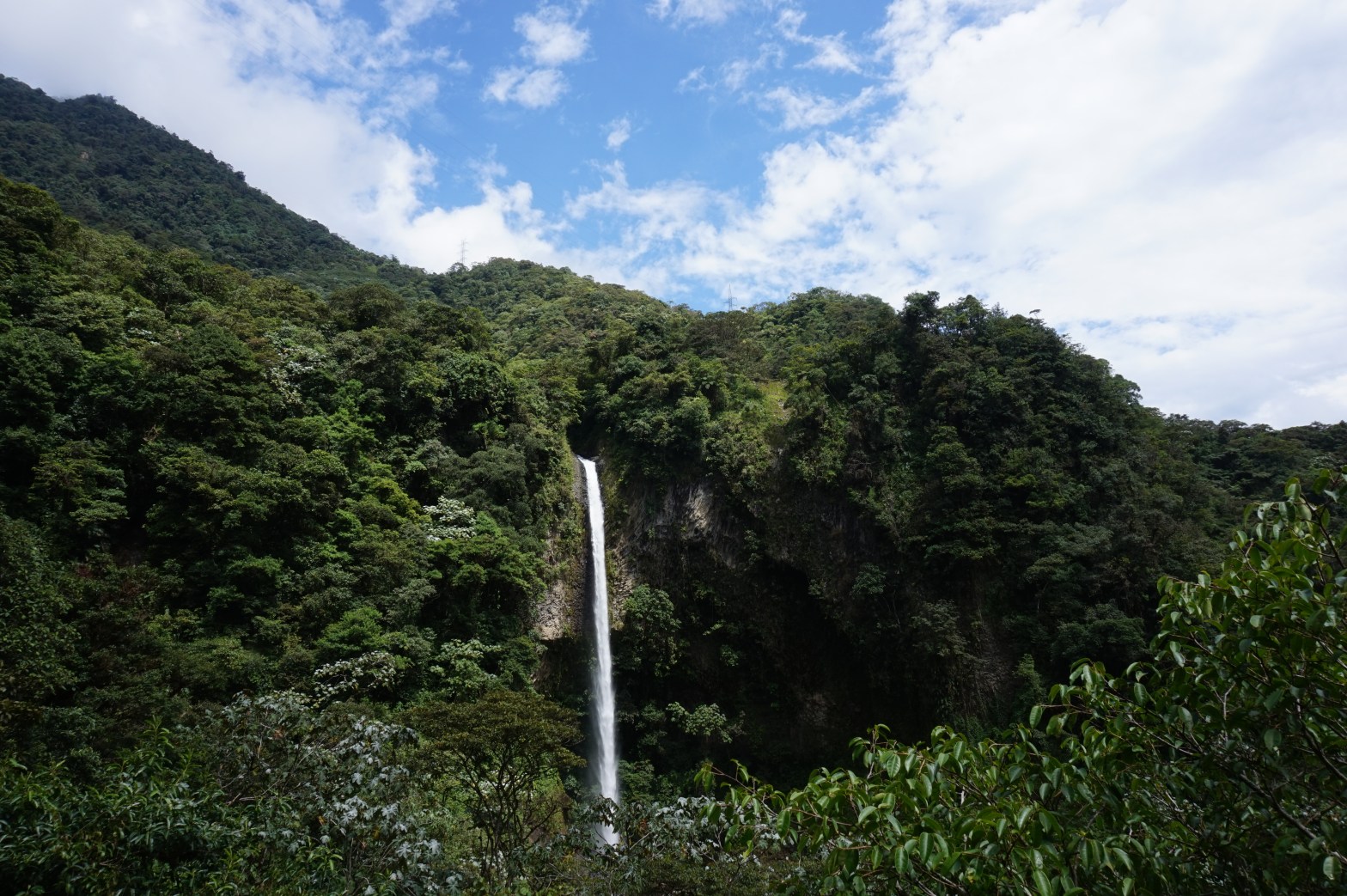
The first day we rented some mountain bikes to use to explore the various waterfalls that were located along the ‘Ruta de las Cascadas’, the main road leaving the town. It cost $5 to rent the bikes for the whole day which for me is an incredible price for an area that is so touristy and that also has so much to see. The road out of town had some traffic but it wasn’t too bad to ride with the occasional cycle specific route around the mountains when the vehicles entered the tunnels beneath them. The scenery for the ride was beautiful and there were scattered waterfalls along the way to stop and admire or take a breather. The route was leading to the main attraction of this well peddled path, ‘El Pailon Del Diablo’, a big powerful waterfall with viewing balconies built into the surrounding cliffs.

I think the river was separating 2 different land owners because you could enter from both sides and get 2 different perspectives, but you had to pay for 2 different tickets. The prices were cheap, a couple of dollars, and it was worth it for the experience. There were paths bringing you closer to the waterfall with scattered balconies and passing points. The closer you got, the harder the path became. At times you were crawling on a path but under a cliff with not much space for the larger folk. You could worm your way closer until you were able to stand behind the barrage of crashing water. You needed to have a poncho and hide your electronics here because the air was full water, it was impossible to stay dry.
Further up the road after El Pailon Del Diablo, lies another waterfall very spectacular to see. ‘Machay’ was possibly a little bit taller than the previous waterfall but didn’t have as much water flow. And although there wasn’t an actual path, a short walk could allow you to enter the pool at the base of the waterfall. I managed to get there but really struggled to get in and swim. The sheer force of the falling water created a thunderous roar, a wind that arrived in waves of unforgiving gusts and an actual wave that was constantly reminding you of who was in charge here. And the water was pretty cold too. Just feeling the incredible power of nature from so close was good enough but the added bonus of a free shower makes it even better.
You could ride further up this road and probably encounter more things or more waterfalls but there was nothing mentioned or advertised. So we rode back to the previous waterfall where, because of its popularity, you can find more transport back to Baños. The cycle to these waterfalls is a lot of downhill so there is an option to take a lorry back with your bicycle and save on time and energy. This is what Diana wanted to do so we took a ride back and had time to use the bikes to move hostels in the afternoon. There are lots of activities to do here and the place reminded me a lot of San Gil in Colombia. Some of the activities are more expensive than others but they often require specialist equipment or guides and transport. In Baños you can find activities on the ground, underground, on the water and in the skies, there is plenty to do if you have the time and money.
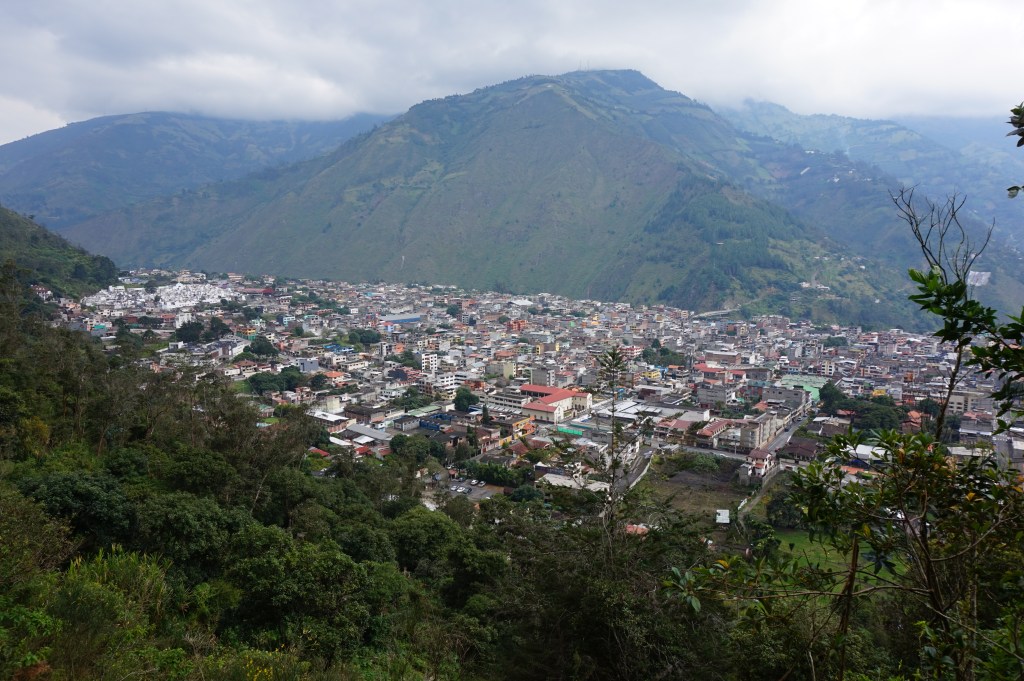
One cheaper and very popular place to go is on top of the hills surrounding Baños. ‘Casa del Arbol’ or The Treehouse, is a property that has 7 different swings including 2 hanging either side of a treehouse. But it also has a view of the other side of the mountain and, if it’s a clear day, it has a view of the volcano. It costs a pittance to get in and you can linger around for as long as you want. We went up by public bus and waited around for the clouds to leave the volcano. What actually happened was the clouds got worse and engulfed us in a complete white-out. It was getting later on and starting to get a bit cooler. Diana wanted to take the bus but it wasn’t leaving for an hour. I wanted to walk and keep warm and then take the bus as it passed me on the road.
So off I walked leaving Diana waiting in the bus. Within 2 minutes of walking, I had manged to hitch a ride. A group in a pickup stopped and let me jump in the back and they happened to go past my hostel too. I was home in 20 minutes and had a nice warm cuppa in my hands. The next day Diana wanted to do canyoning, which involves walking down a river valley and abseiling down the waterfalls, but I was going to skip it this time seeing as I had a limited budget and I had done it before. Instead, in the afternoon I went for a walk to the Jesus cross and viewpoint that looks over the town. Along the first heavy uphill section of the walk I came across another tourist walking up. We ended up walking together and upon arrival at the cross, she said she was walking further up.
I joined her and we continued up to the extreme swing which was situated at the top of the mountain looking over the town. When we arrived, the workers got excited but we weren’t interested in using the swing, we just wanted to see the view. The guys were nice enough to let us climb the viewing tower, the only problem was the cloud restricting vision any further than 20 metres. But as if by magic, the clouds suddenly dispersed revealing blue skies and the view of the valley. And within a minute, it was cloudy again. We were on our way to find the way down when we realised we were close to a volcano viewpoint so we went to check it out. It was nice, but a little bit further up there was a better viewpoint, so we went looking for that one. Eventually we ended up halfway to La Casa Del Arbol and seeing as my walking buddy hadn’´t been there yet, we decided to continue.
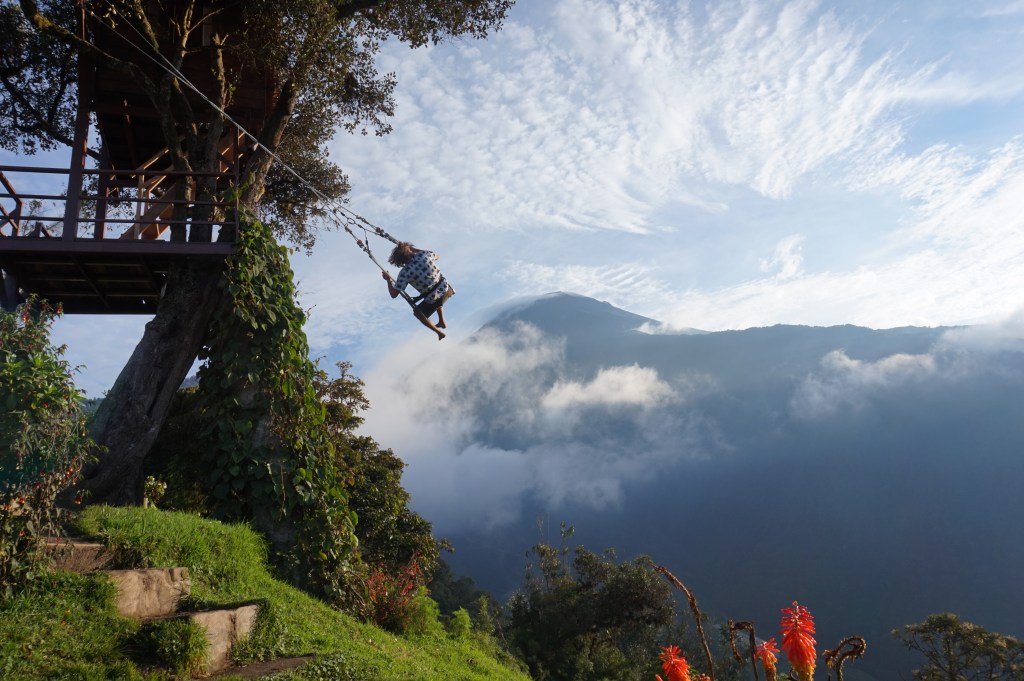
Today was much busier than yesterday and the sky was also much clearer with the clouds that normally adorn the peak of the volcano regularly clearing to reveal its entirety. Having listened to my friend scream on every swing, to the amusement of everyone, it was time to head down. Rather than returning down the road, we wanted to go across the mountain and down the other end of town next to a Virgin Mary statue overlooking Baños. The sun was starting to set and the light was starting to dim. We were still a long walk from home and walking paths unknown, and at some point unstable. This was when my friend starting telling me her story about being rescued from a volcano by helicopter because she got lost and slept the night in a woods, singing to survive. I had been following her the whole time thinking that she was the responsible person in our pairing who knew where she was going.
Seeing as we had limited time and we had seen a bit of Baños already, it was time for Diana and I to move on to Cuenca. I don’t know why we were going to Cuenca but it was a popular place on the backpacker trail. It is a nice city with some things to do round it. On our first day there, we bumped into Matteo in the street and went for a walk to a viewpoint above the city. The next day we took a long stroll around Las Cajas National Park which can be fairly cold with its climate and altitude. The walk itself lasted a few hours and took you through a landscape that wouldn’t look out of place in Scotland. The weather as well. We were lucky that it didn’t rain until we were walking on the road on the way back to find a bus.
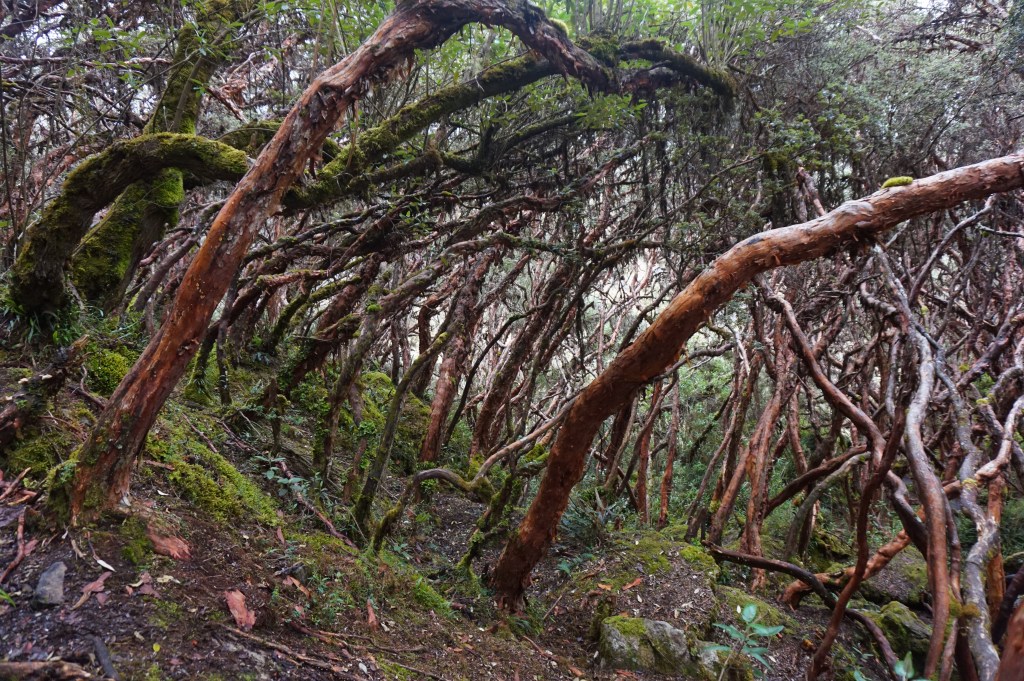
The walk through the park takes you past lakes, mountains and along many different trails. You will also enter a tangled forest of red barked trees that twist around each other and the rocks. The forest was an enchanting place to walk with every angle tempting you into taking another picture. The same can be said for the rest of the scenery too. Having completed our circuit and having seen what we wanted to see in Cuenca, for me it was time to head up north and try to get out of Ecuador. Diana had a couple of days more than me so she stayed in Cuenca for the night. I took the night bus to Quito and as soon as I arrived in Quito, I took a bus north to El Coca. This was where I was before, when I went to the Yasuni National Park, so I was confident arriving after dark.
I was also unable to leave the next day due to the silly organisation of the border up here. From El Coca, you had to take a boat for over 200km to Nuevo Rocafuerte. Here, you had to get lucky and find a private canoe heading the 20km, or 2 hours over the border and into Pantoja, a small village of 500 people. This is where you can get your entrance stamp to Peru as long as you remembered to get you exit stamp in El Coca 2 days ago. They recently moved the immigration office over 200km from the border and a 45 minute walk from the docks were you arrive. This was catching many tourists out who were having to return back to El Coca and waste 4 days on the travelling. The boats passing around here leave around 6-7am on most mornings but the immigration office doesn’t open until 9am so it’s impossible to do it in one day.
I was well informed about the situation before hand and had even arrived earlier than expected in El Coca. This meant I was relaxed and ready to go early the next morning and start my long journey across the border and through the Amazon. Once I crossed the border, I had a 5 day journey planned on a cargo boat to Iquitos, the jungle capital of Peru. After that, there was another potential 5 day journey away from Iquitos to a destination currently unknown. That meant stocking up on supplies and necessities in El Coca, for a potential fortnight of low key, economy travel. Fortunately for me, I met 3 Italians on the boat from El Coca to Nuevo Rocafuerte who I would journey to Iquitos with over the next week and a bit. They definitely improved the enjoyment levels during the following days to come.
 Going Feral
Such beautiful scenery and amazing experiences. It would be so interesting to know how many miles you have walked! Lots of love xxx
LikeLike
Banos looks nice – I wanted to go but we didn’t have enough time when we were in Quito.
LikeLike
It was, you should go if you get the chance in the future! 😁
LikeLiked by 1 person
Hopefully would like to do a bit more travel in south america.
LikeLiked by 1 person