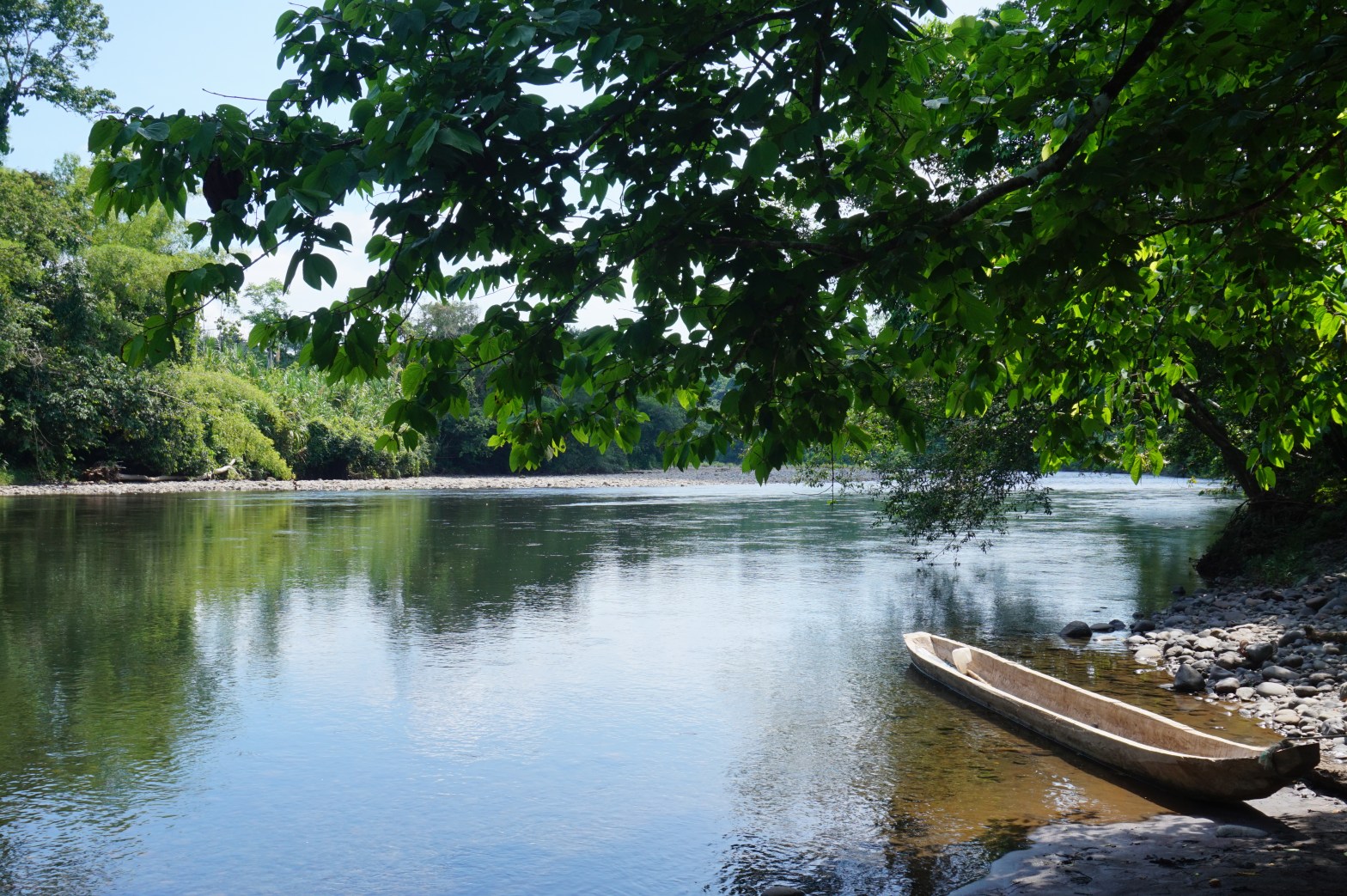
Leaving the Yasuni National Park, and El Coca, my route headed along the road in the direction of Tena. There are lots of little towns, villages and indigenous communities along the way with loads of waterfalls just a short walk from the main road. The local people charge a minimal fee for entering the private land that surrounds the rivers and although it is not much, it can build up if you’re chasing waterfalls for a day. There is not much tourism around this area of waterfalls so I would imagine the entrance fee helps out a bit with the maintenance of the paths.
One of the waterfalls I visited, called Carachupa Pakcha, was located about an hour by bus from El Coca. It is easy to get a bus there from the main Terminal in El Coca and as it turned out, it was even easier to hitch a ride. The couple who gave me a ride weren’t too keen to talk with me, they preferred to carry on their conversation about their friends cheating on each other. It didn’t matter as I was extremely grateful for the free ride. Anyway, Carachupa Pakcha was marked as a little walk (2km) from the main road behind a small indigenous community. It turns out the map was wrong but I couldn’t really get lost. There was a 2 lane gravel road that had been fairly recently built leading off the main road. This passed through the community for 100m and then continued for another 4-5km through a slightly demolished jungle.
I went to this waterfall on a Sunday at around 9 am and half the community seemed to be still drinking from the previous night. The walk out of the other side of the community was long, hot and very quiet. Having already passed the waterfall on the map, I was putting my faith in this completely out of place road as it continued further and further on. Eventually, I came to an opening, the end of the road and an entrance marked by a few well-made buildings and some statues as well. But there was nobody there and nobody to tell me where to go. There were 2 main paths leading into the jungle and many routes coming off of them. In this moment a bus arrived and I quickly picked my entrance to try to get to the waterfall before the crowd.
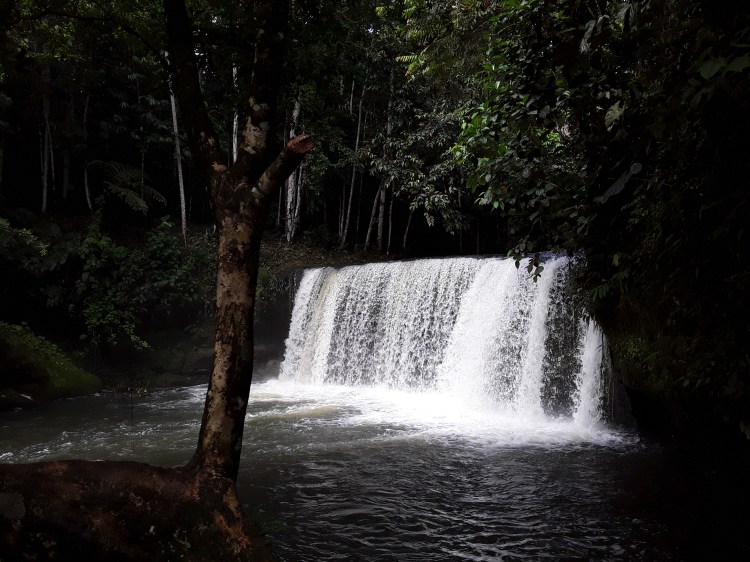
The waterfall was a 10m wide curtain of water dropping maybe 4m to a pool where you could swim with ease. The hole in the canopy above the waterfall allowed the sun to illuminate the cascading water, lighting it up to reveal its beauty. I was able to swim peacefully (apart from the thoughts of what might be lurking beneath me) for a while before the busload of people arrived. Around the Carachupa Pakcha waterfall, there are also many trails that navigate through the light jungle and to other parts of the river. The path I took from the waterfall eventually led me out to the road, but it seemed more like a secret entrance for the local people than an actual trail. The walk back to the main road seemed even longer, especially as it was now the middle of the day, extremely hot, with clear skies and no shelter.
From the main road, I managed to catch a bus to Tena where I heard it was a beautiful jungle city. I found a cheap place to stay and like most of the cheaper places, they were on the outskirts of the town. This one was perched up on the hill overlooking Tena, it was a beautiful view and away from the busier city. It was also up a big hill that wasn’t very nice to have to climb on a hot afternoon. My favourite part about Tena was the Parque Amazonico La Isla del Amor (Love Island Amazon Park). It used to be a zoo but when it lost its funding it had to close down. You are free to enter it and walk around, and you can walk around the place for a few hours. There are wooden walkways passing through this 1km by 200m peninsula between two rivers allowing you to wander through the trees with peace and quiet.
There were a few people walking around but you only saw them as they were congregating around the Squirrel Monkeys that were still living there. The monkeys weren’t quite as accustomed to humans as those in Panama but with caution, they came down close, especially when I waved my banana at them. Other than the family of monkeys, there wasn’t much fauna left behind since the zoo closed down. The old cages and pens were there as a clue of what used to live on this land, each telling a story as you meandered through the park. And when the wooden decking stopped, I continued along the concrete supports that were starting to get engulfed by the jungle around it. The unfinished paths went further into the distance before ending up at a couple of buildings that resembled an auditorium or performance area.

There were many old buildings currently left abandoned with varying states of decay. Even further along the undecked path, I came across a tower made with a metal frame and wooden flooring. It didn’t look in the best of condition but it looked very high which meant it probably had a nice view from the top. To reach the top you had to climb a spiral staircase, complete with missing steps, up 4 floors to reach the best view. It was alright but nothing special. A bit overgrown but still nice. After a couple of hours I had explored the whole park and there wasn’t much more to see, so I walked through town and back up that sweaty hill to the hostel.
A bus ride away from Tena you could find a small town called Misahualli located along the River Napo. It was very quiet with not many tourists there but they still had touts selling tours as I got off the bus. I ignored them and walked across the park and towards the river. That’s where I encountered the Capuchin Monkeys, in the centre of town, climbing across roofs and walking across the street. They looked like they were scouting for missions to steal food and they were. They wanted to enter the freezer of a truck that was delivering chickens to a restaurant. They also stole the whole display of nuts from one shop before losing the prize to a helpful person in the street during their escape. These monkeys were residents of the town and although they had thieving tendencies, the locals seemed to like having them around the place.
I walked to the water and had soon haggled my way onto a tour for very cheap. The guy told me that everything was included and we would be doing this and that and we would see this and that. It turned out he just wanted my money and the tour was something different but it still turned out to be nice for the price. We travelled the river to a local farm that had been set up to receive tourists. Once there, you had to pay extra to tour the farm or you could wait in the entrance. We were shown how the indigenous people lived off the land and how they hunted and fished. Some of the traps they had were simple but effective. For example, a long basket made from bamboo was placed in the water at an angle because the locals knew a fish that couldn’t swim upstream or ‘uphill’ meaning once it entered the basket, it couldn’t get out.

Other traps they had were much more brutal. Made completely from trees and fibres found in the jungle, and generally using a trigger system, there were different methods adopted. One trap had the system that when the trigger was knocked, it would drop a heavy log squashing the animal dead or pinning it to the ground. Another had a noose that once triggered would tighten around the animal and catapult it with lightning speed. The only problem was that the noose was now attached to the animal so when it was catapulted, it would violently break the animal’s neck or give it severe whiplash. Whatever the method, the traps looked very effective as well as intricate in design and functionality. I took lots of photos just in case I ever got lost in the jungle and had to hunt my dinner. Although thinking about it, I would need my computer with me, with enough battery, to view the photos and build the traps.
The boat then took us to another community which was much larger. Here we were able to buy things from the local community and pay for traditional shows if we wanted to. There was also a walk that had to be paid for that took us up the hill to a viewpoint looking over Misahualli. The walk up the hill was pretty intense in the heat and even more so for the three others on the tour. One was an ill American who wasn’t in the best of shape before her illness had its effect too. The other two were an old Ecuadorian Couple who again weren’t in the best of shape mainly and at their age they had knees and hips that didn’t work like they used to. I took the role of cheerleader and motivational speaker as we dragged them up the hill. Once at the top, we took in the view for a bit and then took a different route back down that was a little less vertical.

Nobody wanted to pay extra to see the shows as I think the others had been misled too. Also, one of the shows included using wild animals that they had in captivity or showing us the animals from the jungle that they were holding just for touristic purposes. At this point, we headed back to the boat and back to Misahualli to end the trip. We had to hurry because the captains’ kids were waiting in town after school and needed a ride from dad. This was a good time for us to end it too with my stomach starting to ask why lunch was taking too long.
After lunch, I took the bus back towards Tena before jumping off halfway to visit another waterfall, Cascadas de las Latas. This one was about a 1km walk from the main road and cost $2 to enter and use the paths on the owners’ property. There was nobody else there so I had the walk to myself and the surrounding nature undisturbed as I wandered through. The path ran more or less alongside the river with detours taking place when the path was too muddy or became obstructed by a fallen tree. The walk wasn’t too long or strenuous even though it was uphill the whole way there. Once I arrived, I had the waterfall to myself. I tried to take a photo on a timer and get myself underneath the waterfall for the pic. I failed miserably many times with the slippery rocks, powerful water, and my complete uselessness leading to utter failure.

The walk back was much more interesting seeing as I decided to follow the river all the way down. With this route, I encountered many more birds and insects as they congregate around the water. I also had to climb down a couple of small sections where the water just dropped a few metres and there were no clear or obvious routes. Still, the route back was easy and more fun than the way up, I just had to keep my bag dry during the swimming parts. I made it all the way down the river and to under the bridge that had my bus home passing by as I arrived 1 minute too late. I climbed up to the main road and tried to hitch a ride. No luck this time but eventually another bus came to get me back to Tena.
From Tena, I decided to head back along the same route I had just come because I had heard about a location where you could see many parrots and macaws. El Saladero Llumochaurco is basically a rock wall next to a river that has salty minerals in it where birds and animals come to lick for nutrients or maybe for fun. Either way, every morning they would come to feed and I wanted to be there to see it. The only problem was that there was no information about its location and nobody in the nearest town knew the slightest thing about it. I found out which community it was near, but the community’s location was also unmarked. I eventually found a way to get there and I borrowed a tent from a local guide so I could stay the night to be there in time for 6 am.
First off I had to get there and there were only two options. One was a morning Chiva and the other was an afternoon Chiva (a lorry that has been converted into a bus). The Chiva left the main road and slowly made its way into the light jungle passing farms, houses, and communities along the way. We continued on, dropping off people along the route until we eventually made it to the community at the end of the line, Macanacocha. Upon arrival, I became an instant attraction with not many, if any tourists coming here. In fact, they kept telling stories of a French tourist who came here 3 years ago so maybe he was the last person to come here? Anyway, there was no reservation system or contact so I had to start the task of finding how to get to the salt wall.

I found the guy who was the guy to talk to (whose name has slipped my mind), and I told him what I wanted to achieve. He seemed confused as to why but offered to show me the way and make this work. The walk is only 15 minutes or so but it is an overgrown and unmarked path that goes through the fields and crops of the village. Once we arrived at the river he showed me where the parrots come in the morning and all the other information I needed to know. We also chatted for a bit before he started to construct a hideout from the palm fronds surrounding us. The basic, but effective, construction technique using just palm fronds (and logs for a bench) took us about 30 minutes to make at a leisurely pace. Once completed, it blended into the scenery seamlessly and enabled me to view the birds without disturbing them or without them even knowing I was there, unless I broke wind of course.
Now I had to set up my tent which meant clearing an area of sharp things and then flattening it out. The machete works well for this and I had my area ready in no time. With the tent up and everything ready for the next morning, I went for a walk to see the bigger river that flowed nearby called the Rio Suno which eventually flows into the River Napo and then the River Amazon. The shallow river was quite strong but I wanted to cross it and get to the island in the middle. I almost lost my shoes on a few occasions with them coming off my feet before trying to float downstream. Once I made the tiny island, I found a nice calm spot on the other side where I could swim. After exploring more I headed back to Macanacocha to entertain myself in the community.
The village was built in a square around a football pitch in the middle. As I walked around the empty community, I came to the school. I popped my head in to say hello and the children were so frightened, they ran to the other side of the classroom. The children calmed down with time and started to approach but even the slightest twitch by me would send them chaotically running to the other side of the room again. Not wanting to disturb the class anymore, I went over to the seating area around the basketball court/five-a-side pitch. Within a short spell, I was surrounded by children, still scared but curious to see what this weird looking human was. I soon became boring and the kids started to play football.

The standard of play wasn’t of the highest calibre and the concentration levels were incredibly poor. One kid stopped focusing on the game and decided to swing a cat by its back legs until it was close to being sick and then he released his grip sending the cat flying through the air. Let’s just say that cats don’t always land gracefully on their feet. Fortunately, the dizzy kitten managed to stumble away before the devil child could get hold of him again. Th other kids were just having a meeting in the middle of the pitch until the ball hit them. Then they would run frantically chasing the ball and kicking anything that was in their way before they got tired and started chatting again. As I said, the standard of play wasn’t the best, but the entertainment value was very high.
I headed back to my camp by the river before the light dropped, with the 15-minute walk being easy to get lost in the dark. I followed the snapped stalks and leaves that I had made on the way out to make sure I didn’t get lost and arrived back with ease. When I got back to the camp, large black ants had swarmed all over the tent as well as my socks and boots too. Using a palm leaf, I swept them off but they kept on coming back and trying to bite my feet. I think they were enjoying the heat that the tent had absorbed during the day and was now giving off. At least they weren’t bullet ants or something else that would cause serious pain when bitten or stung. Giving up, I prepared my dinner which consisted of tuna rolls and random individual package cakes. I made sure I hanged my rubbish away from my tent in a ploy to draw the critters away from me.

I had heard that some animals would come at night to lick the salt wall and during the day I had found a hidden spot to watch them from above. Once the light had dropped, I crossed the river and took my position above the lick zone. I lasted about 1 minute before I was swarmed by a vast amount of bees looking to defend their nest. I know these stingless bees as ‘hair bees’ but they come in a variety of names I believe. Seeing as they don’t have stings, you might think that they are more of a nuisance than they are harmful. They are both. They like to fly into hairy areas on your body and manoeuvre through the hair to the skin. Once they arrive there, they bite you and they bite you hard. I have seen local people run for safety once they come across a nest. I tried to do the same but I was in a precarious position, in the dark, and I didn’t want to make matters worse for myself.
I slowly climbed down to the river as quickly as I could whilst simultaneously trying to remove the bees from my thick, tangled hair before they bit me. Once in the river, I tried to remove them all but they were incredibly persistent. I must have spent 20-30 minutes picking them from my hair first and then from my clothes. I want to reiterate that these little buggers bite hard and therefore I wanted to make sure that I had removed them all before I was safe to relax. After this experience, I gave up on trying to watch the salt licking animals and decided to hide in my tent instead. With an early start needed, I had no problems trying to go to sleep early and with the soothing sounds of nature, it shouldn’t be too hard. As I was just about to drop off to sleep, something bit me hard. As I grabbed it and removed it, something else bit me and then another. Some of the hair bees had smuggled their way into my tent and it seemed like they coordinated their attacks at the same time to be more effective.
I spent the next 20 minutes searching myself and my tent to make sure I was finally alone. I didn’t want to be awoken by another bite so this time I was much more thorough with my search. As I started to sleep again, the rain started to fall. As it got harder and harder, I soon found out that the tent I had borrowed wasn’t quite as waterproof as it was meant to be. This was a problem that I couldn’t really fix in the dark, in the jungle, in the rain and in the range of scalp eating monsters. So I positioned my equipment and my body out of the way of the drips, and the trickles of water starting to run inside the tent, and hoped it didn’t get worse. I also hoped that the rain had stopped in the morning because the birds don’t really like the rain and generally take shelter.

When I awoke in the morning, the rain was still present. I made my way to the shelter at around 5:30 am and waited patiently in silence. The parrots and other birds should come to eat between 6-8 am but the rain persisted at a sufficient rate of downpour to keep the birds away. I could hear them flying around beneath the canopy and talking, but they weren’t willing to come out and eat. I had basically spent a horrific night of being attacked and sleeping in puddles, to just stare at a wall for 2 hours. The birds never arrived and by 8 am, it was time to call it a day and pack up in the rain. I headed back to Macanacocha where I had to wait for the bus. I was late for the supposed bus time but it comes when it comes around here. The locals said that it hadn’t arrived yet so I just had to wait.
The guy who had shown me to the salt wall was there in the morning. He also had a pool table at his house so we played pool until the bus arrived. Local knowledge was definitely important on this table as it had seen much better days. We managed to get a few games in before the bus came, to the delight of the 15 strong crowd of children that had arrived from around the village. The village community of Macanacocha lived a lot from the land, eating what they could grow and selling the rest. Now there was a bus to the main road and transport to the larger cities, the community was able to go to Quito in a day and sell some produce before returning the next day. Before the road and bus arrived here, the community would maybe walk 6 days to get to a place to sell their produce.
Even though it wasn’t a successful trip and I managed to see nothing, it was still a nice experience and worth the visit to see the community of Macanacocha. But I didn’t want to hang around any longer seeing as I had no food supplies, no shops and possibly no break in the rain. So I headed out to try and get to Quito, the capital of Ecuador. I didn’t want to spend too much time in Quito as I had arranged a volunteering position on the beach and wanted to have time to see a bit of Ecuador. I left quickly and headed to Mindo, a village in the cloud forests 2 hours outside of Quito. Mindo is the Ecuadorian version of Minca which lies on the Caribbean coast of Colombia. Both are relaxed towns in the cloud forest with plenty of birds to be found.

There is a lot more to see and do other than birds in Mindo but everything comes at a price. Mindo is very touristic and all the land is privately owned so you have to pay an entrance fee to everywhere. This applies to the many waterfalls that can be found around Mindo including a walk of about 6 waterfalls, all about 15 minutes from the previous. I had met a guy called Gary who had been in Mindo for a week who told me I could get in for free if I walked it myself and just followed the map on my phone. This was the first of many misinformation that came from Gary’s mouth. I later found out that he hadn’t been anywhere in the week he had been in Mindo except to buy chocolate brownies or eat his meals (which were sometimes chocolate based).
I set off early and followed the route on my phone. It was a quiet and beautiful walk along a road that slowly narrowed and became more and more overgrown. It eventually got really overgrown to the point where it was no longer a path and was blocked by a barbed-wire fence. I had been walking for at least an hour and a half by now and I was 500m from where my route was supposed to join the main path. There was no way I was turning back so I had to find a different route. I climbed a few fences, backtracked a few times and probably crossed e few pieces of private land, but I finally arrived at the main path. The only problem was that there was a big fence and gate between me and the road and it was laden with barbed wire. I found the strongest post I could find and flung myself over the fence and back on track.
The walk continued uphill on the quiet road with lots of birds around to be seen. I arrived at the entrance to a cable car that crossed the valley between us and the waterfalls. There was also a walk that went down and then up the valley but not only did both of these cost money, there was also nobody there to let me in. Rather than waiting to pay, I walked further up the hill before I arrived at what looked like the other entrance. Upon arrival, I was met by a really cute and friendly old couple who must have had more than a combined 200 years between them. They wanted me to pay to enter and said I needed a guide. The guide was included in the 3 dollars entrance fee although he was taking too long to wake up so I walked off by myself. He eventually caught up as we arrived at the waterfall. There was a slide built that would end up in the pool of the waterfall. There was also a 12-metre jump that sent you into the base of the waterfall. This was why the guide was there, some ropes were needed to pull you out of the churning water below.
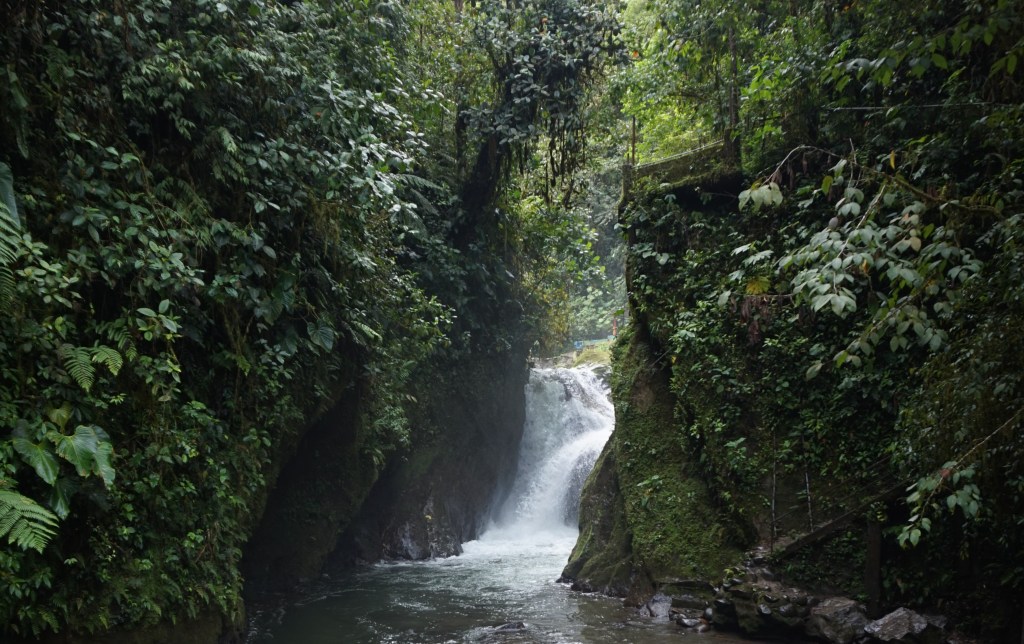
After this, the guide was heading back but I wanted to continue walking and find the chain of waterfalls. Now I was crossing the border between two businesses. The land I entered belonged to the company with the cable car before and yet again, I had nobody to pay. So I entered and walked to the chain of waterfalls. I had left the hostel early for a reason, not because I didn’t want to pay but because I wanted the waterfalls to myself. I also didn’t want crowds scaring off all the wildlife and birds. It was only on my way back from the furthest waterfall that I started to come across other hikers. Like myself, everybody went along the easy chain of waterfalls first before they decided if they wanted to take the long route to the biggest and best waterfall later on. I obviously wanted to go and because I was early, I was there by myself again. But now it had started to rain and it didn’t want to stop.
The rain continued for the hour walk to the waterfall and seeing as I was already wet to the bone, I went for a swim in the ‘Cascada la Reina’. The water was powerful and really cold so it was only a quick dip for sure. I put on my wet clothes and started to trudge off in the rain. The walk back was pretty sketchy with the rain flowing beneath the fallen leaves making the path a slip’n’slide in random places and it was inevitable that I was gonna stack it a few times. I made it back to the junction between the 2 waterfall routes and the cable car. Not wanting to backtrack the vast distance I had already covered, my stomach was telling me to take the cable car shortcut across the valley. This involved paying which wasn’t a problem seeing as hunger was starting to kick in (and I hadn’t paid yet). I still had to walk down the hill and back into town, with nobody willing to give a drowned rat a ride.
After the 7-8 hours and multiple kilometres of hiking, I was good to relax in the evening. The next morning I dragged Gary out of the hostel to take him to see some birds. We got up at 6am and headed to La Casa Amarilla (The Yellow House) where we followed some trails around the forests in the hopes of seeing some birds. The trails and paths are really nice to walk around and we didn’t come across anyone else. We walked all the trails they had and found other trails that weren’t on the map. For the reputation that the place has, I don’t think we were too lucky on the wildlife front. We saw the usual birds that are seen when walking through a cloud forest but none of the exotic birds that were said to frequent this area.

With everything else costing money in Mindo, I walked around a bit more before heading to Quito with Kian, a guy I had met at the hostel. My intention was to spend a day in Quito to sort things out before heading to the northern coast and following it down until I arrive at Mompiche where I would stay for the festive period. What actually happened was completely different. I went for a few beers with Kian that night before eating the street food on the way home. I then spent the next 5 days alone in my room with stomach cramps and a severe loss of fluids. Eating was necessary but didn’t help my situation. After 5 days and some tablets from the pharmacy, I was feeling a little bit better.
I had to head directly to Mompiche now and I had no time to tour the coast. I arrived at Atacames first to break up the journey into 2 days just in case my stomach became volatile again. Atacames is on the coast and has a large beach with plenty of sand. By the city, the beach is packed with locals and vendors selling most things you might need and some things you don’t. The other end of the beach away from the city is quiet and empty with only a few people walking around. I had enough time to walk the beach and back before the light started to disappear meaning I could make it up to the viewpoint on the headland. I was only there for the one night before heading to Mompiche the next morning meaning my accommodation was nothing special. It was cheap and nasty but served me well for the night.
The next morning I hopped on a bus to Mompiche where I would spend the next month surfing, relaxing and doing a little bit of volunteering as well. Upon arrival at The Mudhouse, the hostel I was staying at, I found out that Gary was there. In fact, we had even stayed at the same dive in Atacames the previous night, we just didn’t know it. Gary left the hostel the next day but I ended up staying for over a month in the end. But before my fingers start to fall off, I will save my volunteering at Mompiche for another time.


Thanks Matt for giving me an interesting read while I wait in Harefield for my heart surgery. Lots of love Colleen 💕💕
Sent from my iPhone
LikeLike
A pleasure Colleen. I will try and put the photos up for when you come out 😁
Loads of love xxx
LikeLike
The waterfalls look beautiful and make up for the other “encounters”. Life is certainly not dull on your travels! Take care. Lots of love from us all xxx
LikeLike