Ok, so upon starting to write this I have realised that these parts of my travels started around three months ago. Hopefully, I can bring you up to date as I am starting to make my way to the border and across to Ecuador. And hopefully, I can remember what has happened within the last quarter of the year.
Having left La Isla Escondida nature reserve and seeing as I was already so close to the Ecuadorian border, it seemed like a good idea to renew my VISA here. I was able to skip across the border and return the next day and I would have an extra 3 months to spend in Colombia. The other option is to go to an immigration office and pay 96 mil pesos (30 US$) and have the same. The better option was definitely the border hop option seeing as the transport was cheap and the border so close.
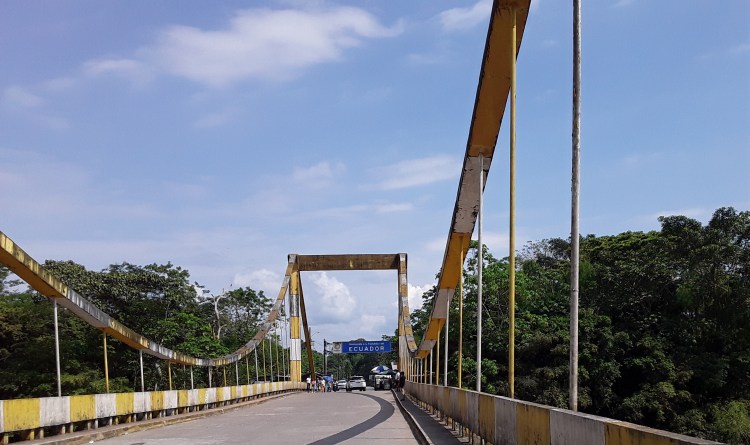
I crossed into Ecuador with minor delays due to Venezuelan families crossing into Ecuador looking to escape the turmoil back home. Once I pass through to Ecuador, I needed to take a bus and then get off the bus 3km later to stop at Immigration. It is my responsibility to stop and get the correct stamps for my passport and without these, I can’t get the VISA once I return back to Colombia. Seeing as I planned to head to Ecuador after Colombia, I had no intentions to explore, I was just here on business. Saying this, I went to the nearest town to the border and found a bed to stay in via Couchsurfing.
For those of you not familiar with Couchsurfing, it is a platform that allows you to find places to stay, free of charge, with local people all over the world. The idea behind it is not to travel for free but to meet different people, share cultures and maybe learn a thing or two. I found a bed in Nueva Loja, the nearest town to the border, with a really nice family. It was one of the first times the girl was using Couchsurfing but her brother and family were experienced with it. Upon arrival, I managed to meet the whole family including the mother, step-father, brother, sister, sister’s boyfriend, daughter, cousin and uncle I think.
I arrived fairly late on in the day so I pretty much only had time to eat some local food for dinner and take a drive around town for a little tour. Nueva Loja is definitely not a location for tourists and apparently has a problem with Venezuelans robbing and attacking people. The stepfather had stitches in his head from one of these incidents but that doesn’t mean it wasn’t a one-off. I often hear stories about how bad the Venezuelans are but have never had any issues. I have also met many really nice Venezuelans and have many friends from there. Maybe the small minority of bad ones are tarnishing the name of the many good people there are.
Anyway, I don’t think I will be heading back there soon, and the next morning I left fairly early to make my way across the border and back into Colombia. I had planned to meet Max and Marthe, the French couple who worked in Jungleland with me, for a few days whilst we were close by. They were volunteering outside of a town called Mocoa which is a place that has grown rapidly over the last half-century. Based around a junction between a few roads, many people who passed through the small village of Mocoa ended up staying. Over the years it grew and grew until it became the size it is now.
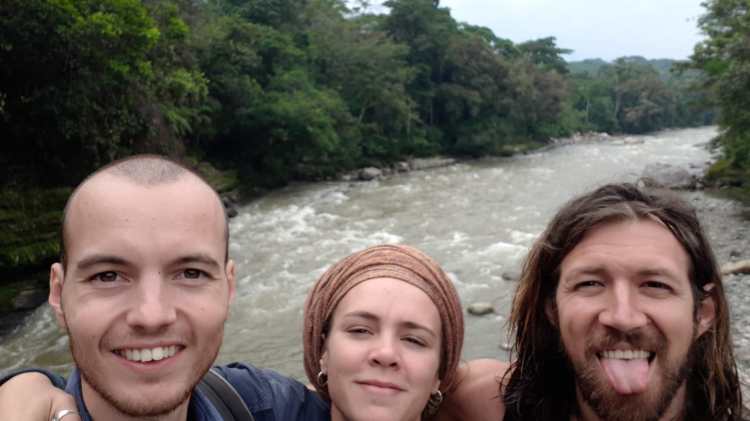
The area and department of Putumayo has a history of ceremonies using the ayahuasca plant, or Yagé as it is known in Colombia. Anciently used as a medicine, nowadays it is more of a tourist attraction with many of the hostels doing ceremonies for people who stay with them. 10 minutes after arriving, we were offered to take part in a ceremony but it wasn’t something that interested us. We were looking to go on a hike and explore the beautiful countryside that this place had to offer. We were staying in a hostel that was just inside the entrance to one of the hikes they had in Mocoa called ‘El fin de Mundo’ which translates as ‘The End of the World’.
This was the name of a waterfall of reasonable height with some swimming areas below. You were able to go to the top of the waterfall and look down over the edge, and the drop down is where it gets its name from. Because of its height, a safety harness was required to look over the edge and therefore a guide was needed and subsequently payment was needed to. Seeing as there were plenty of free hikes around, we decided the better option was to save money and do one of them. The guy from the hostel had given us brief explanations of how to get to some canyons and swimming areas where we didn’t have to pay so we decided to take these on.
We walked off in the direction of Mocoa from our hostel and after a while, we came to what we thought was the entrance to the hike we wanted to take. About 50% of what he told us was visible and the other half was a mystery. Maybe we were just witnessing many coincidences and we were walking on completely the wrong path or maybe his directions were just really bad and half made up. Either way, we were hiking through nature and enjoying where we were. As we continued onwards and upwards, the path became less and less obvious and slightly harder to follow. It was also clearly a path that wasn’t regularly walked which made it all the better for us.
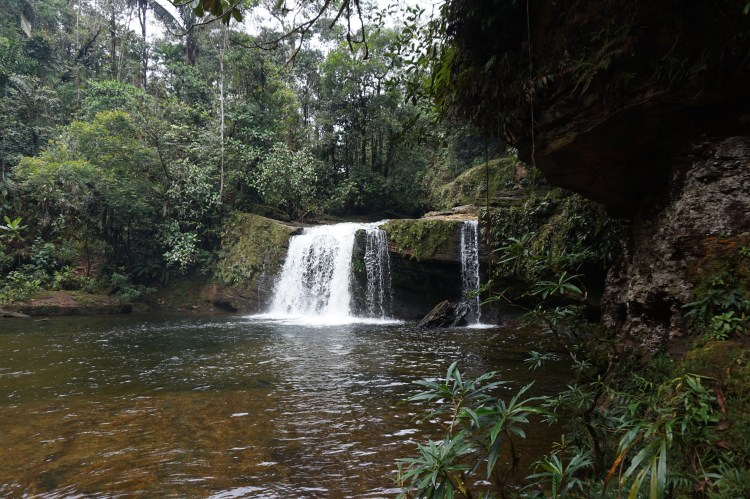
Having now clearly gone the wrong way, seeing as we were yet to reach the canyon in double the time it should have taken, we continued on anyway. There were some beautiful views along the way and birds and animals rustling around us. Eventually, the path came to a junction with another path, but this path was very well maintained with wooden steps and signage. These signs all pointed towards ‘El Fin del Mundo’. Oops! We had accidentally managed to walk the back entrance into this waterfall without paying. Seeing as we were there, we decided to take a look and have a swim.
Seeing as we hadn’t paid and we had no guide, we were unable to get to the top and take a look down. In fact, the wardens tried to kick us out straight away. We managed to hang around for a bit, take a swim and eat some lunch before we headed back to the hostel. We obviously went back the same way we came seeing as it was less developed and more in the jungle than the main path. The waterfalls were beautiful as always but I am glad I didn’t pay the 25 mil pesos to enter. Even understanding the upkeep and maintenance costs involved, it seems a little bit too expensive for what it is, especially when there are plenty of free hikes and beautiful waterfalls around the area.
There is a large waterfall called Hornoyaco, which is amazing to see and free to hike to, just down the road. Halfway between the two large waterfalls is the entrance to the free hike we took which is called Danteyaco (I think) because it crosses the river on Danteyaco Bridge. It is actually now marked on the maps.me app as the free entrance but wasn’t when we walked it. On the way back to the bridge we met a man building a path and asked him if he knew where the supposed canyon was that we were originally trying to find. He didn’t know but told us of kids constantly heading that way and coming back very wet. So we headed that way and within 10 minutes we were at the canyon we had been searching for.
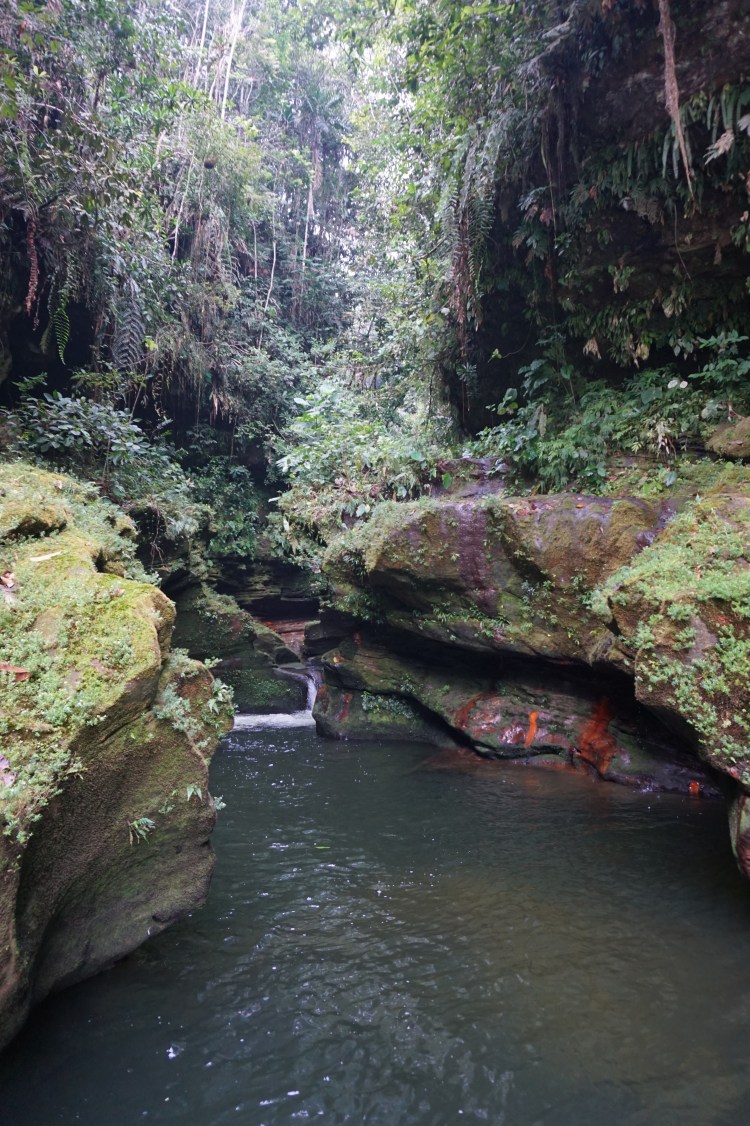
This was a canyon at the point where the mountain river joined the main river that passed under the Danteyaco Bridge. This canyon had areas to jump where the pools were deeper and a little Jacuzzi that went deep down into the rocks. A nice end to our hike, we couldn’t have been luckier in the ways that we got lost. After a whole morning and afternoon hiking up and downhill, our legs were tired and it was time to leave. We collected our bags from the hostel and headed off. Max and Marthe were still volunteering so they headed back to there. I decided to move on but seeing as I had broken my toe at the beginning of the hike that day, I rested for the night and took the bus to Pasto, a small city towards the west, the next day.
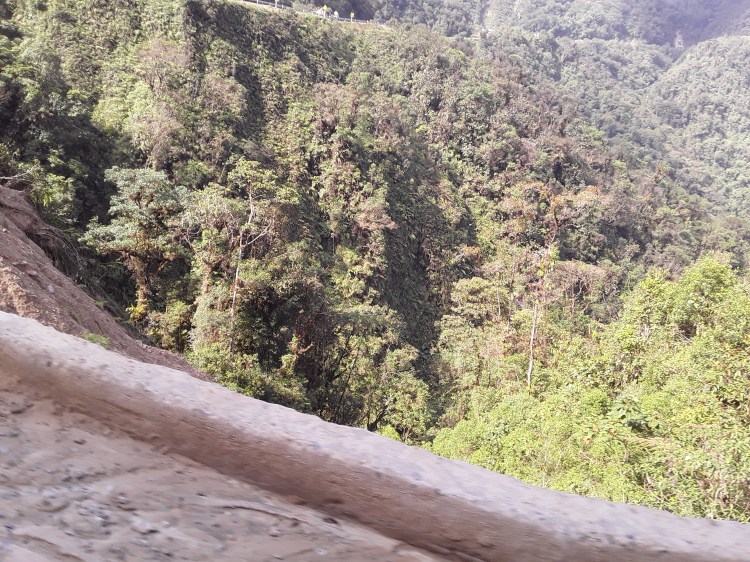
I am not sure if I made the right decision to take the day bus from Mocoa to Pasto. The road that links the two is notorious and goes by the name of ‘The trampoline of the dead’. It is a winding road passing up through the mountains and then down the other side on narrow gravel roads. The road is a lot better than it used to be and is littered with memorials of the people who have died in the past. The scenery was beautiful but sometimes I wish I didn’t have to see the magnitude of the sheer drops below the bus window. Although I did ask for the window seat next to the cliff edge.
Arriving at Pasto 8 hours later, I went to one of the few hostels that exist there. Pasto is a small city at 2800 metres with a climate similar to England. It’s a bit cold, wet and grey. There is also not too much in Pasto to do as it is generally a place people pass through when crossing the main border between Colombia and Ecuador. On the way to the border, about 2-3 hours from Pasto is a smaller place called Ipiales and just outside of Ipiales is El Santuario de las Lajas, a massive church that is hard to explain with words. Definitely, the most picturesque church I have ever seen, set in a valley built maybe 100m above the river on the side of the mountain.
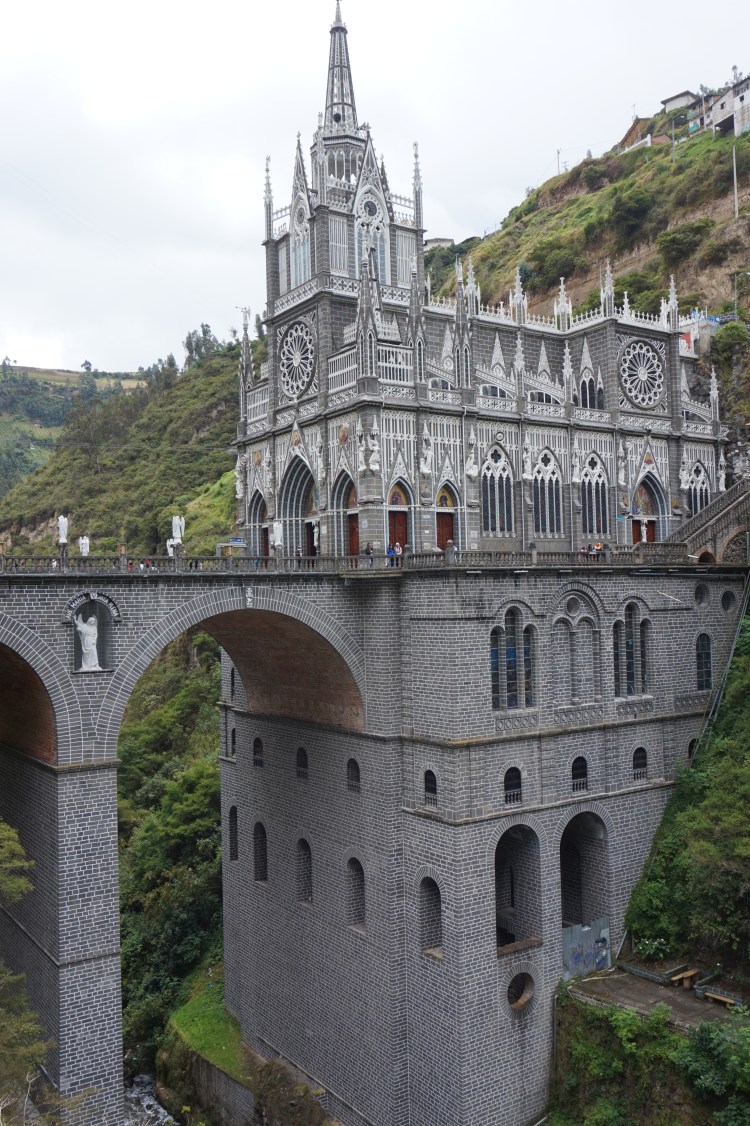
I was lucky to arrive whilst there was a mass or a sermon taking place meaning everybody was inside and there were fewer people outside ruining my photos. It is a place very popular for religious pilgrims with people travelling from many different countries to come and see it. I just enjoyed its beauty and took a walk around for a bit to see it from all angles. With it only occupying 2-3 hours of your time, I headed back to the cold of Pasto where they actually have hostels to stay in. Another place to visit outside of Pasto was a lake called Laguna de la Cocha which is very popular. A beautiful lake situated a little bit higher than Pasto, surrounded by mountains is a very scenic place to visit.
The lake also has the smallest protected area in the system of national parks in Colombia, a little island in the middle of the lake with many species of birds that like to frequent it. The place itself is very touristy and can be very busy at weekends with locals heading there to eat some fresh trout. I ate some trout there and it was delicious and reasonably priced. Getting away from there was a problem though. With lots of people trying to leave, not many buses and no real official bus stops, there was a lot of walking around and watching locals fighting for the minimal seats available. Taking the more relaxed option, we hitched a ride to the main road where we came across a bus straight away that took us back to Pasto and our hostel.
After Pasto, I headed north towards Popayán, the next main town of interest. Popayán is known as the white-city because the majority of the historical centre’s buildings are white-washed. Unfortunately, this leaves a perfect canvas for amateur graffiti artists to write various political messages. But with its white buildings and colonial architecture, the centre of town is a beautiful looking place. And as with many Colombian towns, the central park is a vibrant place where many people go to do many different things. The atmosphere in Popayan’s is no different with many people congregating after work to drink, chat or socialise.
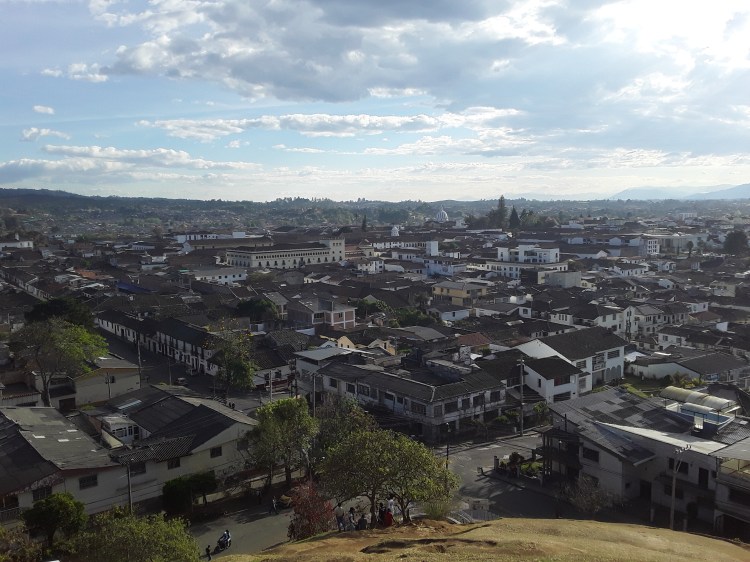
The hostel I was staying in was fairly quiet so I went to the park to chill on a bench and soak up the good vibes around. I had spent about an hour in the park chatting with a few randoms when an old man slowed his pace as he passed by in front of me. He kept looking at me, slowing his speed and continuously looking at me. It was a little bit awkward so I said hello. He responded, came and sat next to me and we chatted for about half an hour. He must have been around 70-80 years old and was a very sweet guy who could understand my Spanish and I could understand his too. He said that he was on his way to his sisters but would come back to the park at around 9:30pm. He asked me to join him and then he could show me a bit of the town.
Seeing as he was very nice, and maybe a little bit lonely, I agreed to meet him. I also thought that it would be nice to learn a little bit of history about Popayán from someone who had been living there for a long time. Knowing that Latinos are always later than they say, I made my way to the park a little bit late. Upon arrival at 9:31pm, I was surprised to see the old dude there already, waiting for me on the same bench. I went to join him and we chatted for the next hour or so about random stuff. He then asked if I wanted to take a walk and see a bit of Popayán to which I agreed.
Thankfully we walked the opposite way to which I had walked earlier so I was seeing a new part of town. As we were walking, he asked me if I wanted to see and old colonial house from the inside. It was incredibly spacious compared to how it looked from the outside and there was an open-roofed courtyard in the middle. He showed me all around the house including the bedroom and then he offered me a coffee so we went through to the kitchen. The kitchen was very basic with a sink, a camp stove and not a lot else. Whilst waiting for the coffee, he kept asking me if I was cold. For me the temperature was fine, I was in a T-shirt and shorts but comfortable. I thought maybe he was ill or had a fever or something.
Anyway, we sat down to drink the coffee and continued chatting. Then he again asked me if I was cold but this time he put his hand on my leg, started to stroke it and looked me in the eye with that look you weren’t expecting or don’t want to see. At the time I felt very awkward but remained calm. Maybe he was just being friendly, maybe I was reading it wrong. But I wasn’t reading it wrong, he had made it very obvious what he wanted and I needed to leave. I thanked him for the coffee and the chat and explained that I had to go, right now. He asked me if I wanted to join him tomorrow to which I gracefully declined. I was a little bit in shock on the way back to my hostel but everything was making sense from the night. As with girls, all the signs are there, it’s that I just don’t see them. At least not until someone explains them or something happens to show me them.

Thankfully the next day I woke up and met people who didn’t want to touch me. I met an Aussie couple and they had the same idea of going to the nearby national park and climbing the volcano. There were tours from Popayán but they were very expensive and out of my price range. But with the 3 of us, it was possible to make our own way there, do everything independently and save some cash. The next morning we made our way towards Purace, the name of the village, the national park and the volcano. Through minimal research, I had found a place to stay at the bottom of the volcano and it looked like the perfect place to base ourselves to explore. I had been in contact with a gentleman called Manuel who had provided me with the information. It turns out that he was like the chief of the indigenous people who lived and run this national park and also the mayor of Purace and the administrator or something. Basically, he seemed very important.
We arrived at a place called ‘Cruce de las Minas’ which was a junction at the base of the volcano albeit at 3288m above sea level. With our backpacks and all our gear, we walked a few kilometres and up to 3400m before we reached our base. The day was beautiful and the view of the volcano was epic. It was a grey volcano capped with wispy white clouds in front of a backdrop of perfect blue skies contrasting against the brownish-grey landscape that surrounded this beast. Not only that, but the birds that frolicked in the trees lining the road on the way up were constantly grabbing your attention and singing you a song along your way. But at this altitude, especially when not acclimatised, the walk was pretty tough.
We arrived at our base which goes by the name of ‘Pilimbala’, which I believe is an indigenous word and has no meaning in Spanish. Upon arrival, we were told by the guy that we had to pay an entrance fee to the national park of 40,000 (40 mil) pesos ($12 US). Beforehand I was told it was only 20 mil pesos. This was another example of the gringo tax where tourists are charged more. On top of this, we had to pay 20 mil pesos a night for the bed (not cheap but a fair price), all of our food on-site because the nearest shop wasn’t near at all, and 35 mil pesos for a guide. I wasn’t happy about having to pay double just for entering the park so as per usual I started to argue. I played the card of Manuel, the mayor, our friend, your chief invited us and said it was 20 mil and eventually I think I annoyed him enough to give us the local rate.
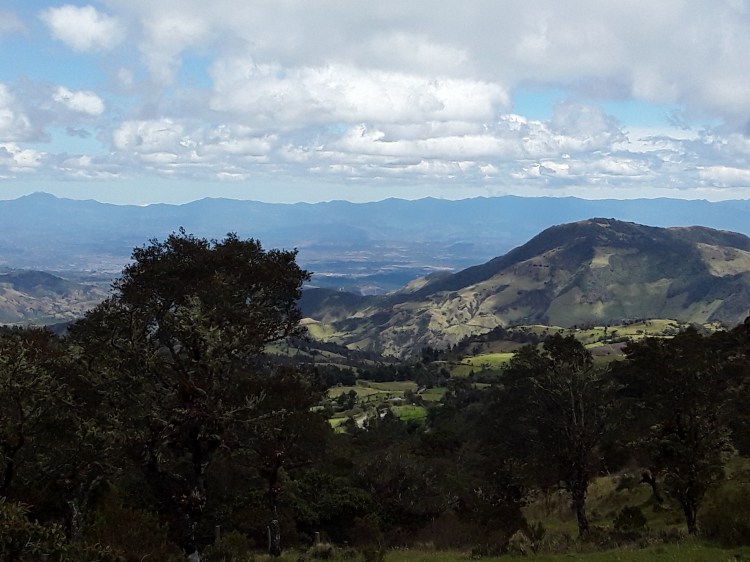
We were the only people there so the accommodation was really good for what we paid. The dormitory was a cabin with 2 bunks and a single bed squeezed in downstairs and two singles upstairs. Zach and Penny being a couple took the upstairs and I had the downstairs to myself. The cabin also had an en-suite bathroom and a small room with a fireplace. This was where we lived, in front of the fire, keeping it burning whilst we were there, to dry our clothes and warm our bodies. It got very cold at night so sleeping was fully clothed under many blankets. The food was reasonably priced too and was standard Colombian food, a soup and a plate with meat, beans/lentils, rice, plantain, and a salad. They also had trout as an option on the menu which was good to know.
The next morning we got up early and met our guide ready to ascend the volcano. He was an old guy, very small and not very talkative. As we started to walk I soon realised that he either didn’t know much, or he really didn’t want to be there. I asked him basic questions about him, his life, the location, the wildlife and he kinda just grunted something incomprehensible and walked off. I asked him during the walk what kinds of birds there were here and he told me there were none. I questioned him and he said it was too cold and no birds lived here. I then asked him what was making that noise then and he said birds and walked off. This was basically a sign of things to come.
The first part of the walk had blue skies, beautiful views, and a fairly continual ascent. We went from 3400 metres up to 4080m in about 5-6km and I think there was a downhill part of about only 100m. A few stages were traversing across the volcano with a steady incline, with the rest being a fairly steep hike, especially the first 30 minutes of the journey. It took about 2 hours to reach the military base at 4080m where we were joined by a group of English lads who took a tour from Popayán and arrived at this point by car. They started to gear up with extreme waterproof clothing, hats, gloves, and facemasks. So was our guide, who must have let it slip his mind to tell us all this. I know we should have researched it a little bit better for sure, but you expect your guide to tell you at the start of the hike that you are going to get hypothermia.
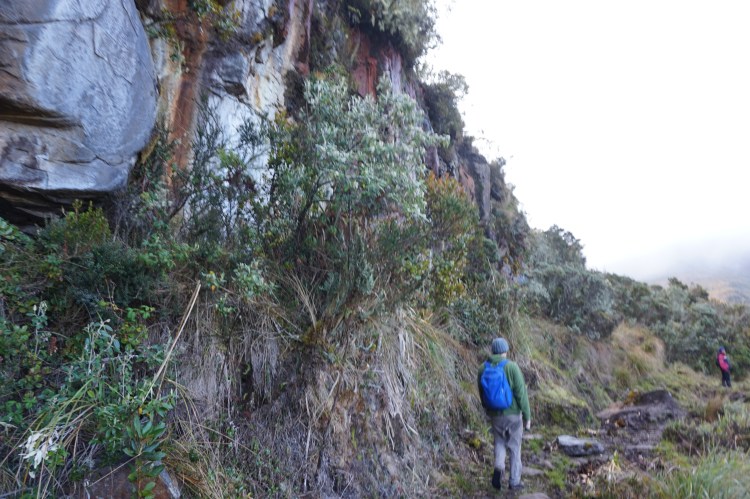
Fortunately, the other guide was kind enough to tell us that our hand-socks were not sufficient protection as gloves and that the driving rain we were about to experience would be freezing cold and would penetrate any clothing that wasn’t waterproof and chill you to the bones. We wrapped our hand-sock gloves in plastic bags we found on the floor of the concrete hut they called a military base. The wind was already penetrating the hut through the numerous holes you could find in the walls, so we had an idea of what was to come. It was going to be a cold and wet 2km hike to climb the last 570m to reach the crater at 4650m above sea level, but the four of us headed out.
True to form, the guide just walked off leaving us to follow him. For an old dude, he was incredibly fit and definitely accustomed to hiking uphill at high altitude. We, on the other hand, were starting to struggle. The wind was strong enough to blow you off balance whilst your tired legs were dealing with the 25% incline and the poor footing on the ash sand slopes. And the rain. The rain was freezing cold and proving to me that my waterproof coat was not actually waterproof. We struggled on and even had a moment where Penny couldn’t continue anymore. She was really struggling and I don’t think her lycra pants were helping with the rain and the cold. The guide was continuing to walk up the volcano whilst we stayed with Penny to warm her up and give her the encouragement she needed to continue.
We eventually reached the peak where there was a big enough rock for Zach and Penny to shelter behind from the wind. The rain was freezing to the rocks up here creating the look of snow, but it was more ice than a snow peak. Normally on a good day, you can walk the kilometre around the crater taking in the spectacular views around you. We couldn’t even see 20 metres in front of us, let alone the crater. I headed to get a better view of the crater whilst the other two took shelter. Because of the sulphur coming out of the crater, it was dangerous to be inside it too long. Also, the wind was intense and nearly blew me in a couple of times. The steep ash slopes would have made a difficult climb should I had fallen in considering the state of my legs at this moment in time. It was time to head back so we collected the other guys and started to head down.
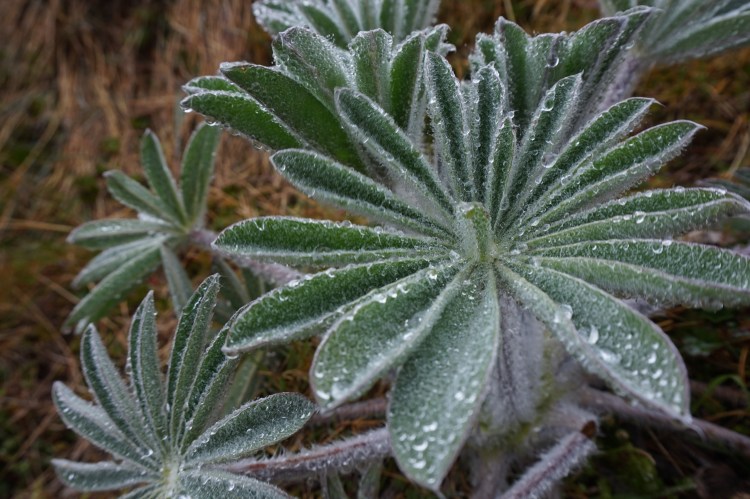
I led the way down and I did so at a good pace. The quicker we walked, the warmer we got and the sooner we could get into dry clothes and get in front of the fire. We took a slightly different route back and walked through the Paramo (basically an area above the forest line but below the snow line) where they have Frailejones, a strange-looking plant which is actually part of the sunflower family. As soon as we entered this area, the weather started to improve and our clothes were beginning to dry. But still yearning for warmth, we continued to descend at a good pace. We arrived back at Pilimbala and decided the best bet was to get straight into the hot water pools, or thermals, that they had at Pilimbala. We even heard about the possibility of a beer, so we asked the guide if he could organise four beers each for us.
There were three thermals of different sizes, all of which were luminous green in colour due to the sulphur. We got in and started to warm our bodies. The taste was disgusting but the water wasn’t for drinking. Both Zach and I took some water on board and struggled to remove the foul taste and burning sensation. Thankfully the beer delivery arrived courtesy of the guides’ 7-year-old son who hiked up from the shop at the bottom. He hung around for a bit to watch us swim but didn’t want to join us. Maybe he knew something about this water. Eventually, we got out, took a cold shower and started the heating process by the fire. Zach was actually in bed and was a bit worse for wear. The cold shower had shocked him into a fever and he was trying his hardest to warm up with no avail.
The next day we were all supposed to go and find some condors but Zach couldn’t leave the bed unless it was a trip to the bathroom. He had some sort of bug and was losing fluids rapidly. Penny and I went to try and find the condors but had no such luck. Rather than waiting for the bus of tourists to arrive, we walked the 1km to the site and saw some other birds along the route. They put meat out to attract them but the weather was overcast and supposedly that means the condors don’t like to come out and play. We headed back having had a nice walk and got the fire going for Zach. Still feeling pretty bad, we stayed the afternoon with him and dried our clothes and warmed our bodies in front of the fire.
The next day we decided not to leave early to try and spot some condors but to head down the hill with the still ill Zach once he was ready to leave. We got down to the Cruce de las Minas, after a Zach toilet break on the journey, and had to wait a fair old time for a bus. Getting bored, hungry and tired of waiting, I went looking for a cup of coffee and some food. True to form the bus arrived whilst I was in a ladies’ house collecting some coffees and bread. I managed to make the bus and we managed to make it to Popayán without Zach making a mess in the bus. He then made the decision to continue on to Cali on another bus and it proved to be a good one. We made it to a hostel together in Cali, which would be the stepping stone to our next destinations. After a few days of enjoying Cali, the salsa capital of Colombia, Zach was much better but I had now begun to feel like he felt previously.
Fortunately for me, Zach was a microbiologist who had researched the parasite that he had and worked out a natural treatment for it. I prefer natural remedies but sometimes they come at a price. Zach told me to make tea using a whole bulb of garlic, a huge lump of ginger and as much cinnamon as I could handle. I had to swallow all the mushy pulp that I had created by making the tea. It tasted absolutely disgusting, a real handful to drink but he had proven it to work. I had a parasite in my small intestine called Giardiasis and it is not very nice. I was losing liquids fast and couldn’t be more than 20m from a bathroom. But after 3 large, painful cups of this tea and a day on the can, I had removed the parasite. By not eating, the parasite had no food and therefore it had no energy or strength. The ginger then rips it from my small intestine as it gets flushed out with the rest of my liquids. Zach had endured 5 days of this but thanks to his cure, I only had to put up with 2 days. I think we both contracted the parasite from the water in the volcano thermal pools after we accidentally drank a little bit.
Having got over the parasite, I felt comfortable to move on. I wanted to explore the Pacific Coast of Colombia and perhaps see some whales. Both of these prospects were a little bit expensive for what I am used to but that didn’t mean it wasn’t possible. I had found a place to volunteer that included free food and accommodation. With these covered, the money I saved in a month I could spend on tours around the coast or maybe head further up the coast to explore the lesser-known parts. But as I finish this post, I realise that I am still 3 months behind the times but one thing remains the same. I have some stomach bug that has locked me up for a couple of days. This time it is not as bad but it has given me time to sort a few things out and catch up on the paperwork. I will continue about the rest of Colombia and into Ecuador in my next update. Until then, take care and speak to you soon.
 Going Feral
Sounds rather eventful with a broken toe, parasite and unwanted advances! Glad all is now well. Brilliant photos and what an amazing church. Lots of love from us all xxx
LikeLike
So interesting to hear of your news. Luckily you escaped the friendly old gent. Shame the parasites are not easily averted. Huge love to you xxxxx
LikeLike