

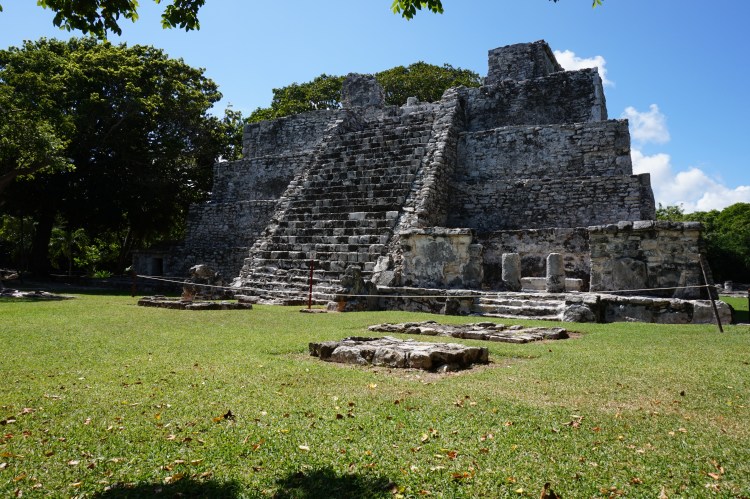
We decided to stay in the Cabanas Mecoloco, next to ‘El Meco’ archaeological site, for an extra day seeing as the Cabanas further up Isla Blanca were 1000 pesos a night (or $60). Basically, they are a rip off. We visited the Mayan site, built approximately 1400 years ago, and were amazed by the amount of Iguana’s that were everywhere. The main Pyramid and surrounding buildings were impressive too, with construction techniques and craftsmanship way ahead of its time. The site itself is relatively small in comparison to others throughout Mexico and Guatemala, but there was a huge amount energy coming from the area, and the pyramid itself was really intense.
Next we decided to go to Isla Holbox and what a brilliant idea that was. Holbox is a Caribbean paradise just 30 minutes by ferry from a small port called Chiquila. It’s beautiful place consisting of multiple islands, with the habitable part made entirely by sand, probably deposited by the currents sweeping up the Quintana Roo coast. The 2 main islands stretch 40km long and about 2-3km wide at its widest point.
As soon as you arrive in port, you are greeted by golf buggy taxi’s that ferry you on the sand roads. The majority of transport modes on the island are golf buggies, scooters or bicycles. Shoes are not necessary on Holbox and even flip-flops are an inconvenience. Originally a fishing island but now heavily supported by tourism, prices are quite expensive compared to the rest of Mexico, for a gringo at least. The cheapest private room we could find was 600 peso’s a night, way above our budget, so we decided on taking a hammock for 100 peso’s, to compensate for the price of food. We did spend one night in a private Cabana, due to the hammocks being full, which was incredibly beautiful but not that private and pretty humid. We managed to find local restaurants away from the main square which lowered our expenditure, and I went to the market every morning to buy ingredients for breakfast and improve my Spanish.
After one day on Holbox, or one cocktail in a hammock on the beach, we decided to ask about jobs on the island. Alex was offered 3 jobs in the first 3 places we asked but the wages weren’t enough to cover accommodation and when accommodation was offered, the hours were so long that we wouldn’t get a chance to see the island or each other. We looked elsewhere for jobs/volunteering, but decided we could come back next year if we wanted to, after we had seen more of Central America.

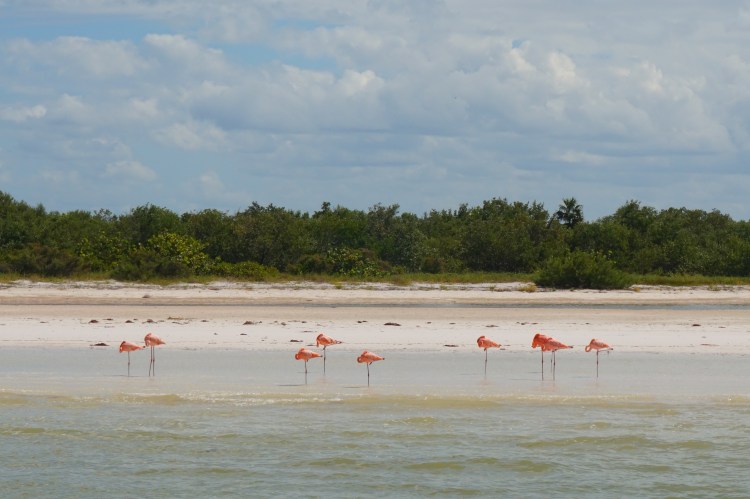
The best way to see the majority of the island and its non-human inhabitants is to take a tour from one of the many guides. Every single tour involves some kind of fishing, followed by cooking your catch at a camp on the uninhabited part of Holbox. Probably sounds amazing to most people but being a non fish eater myself, and travelling with a veggie, this wasn’t something we wanted. The only to get a non-fishing tour was to hire a private boat, setting you back 7000 peso’s. After searching every tour operator and getting the same outcome, we ate some churro’s and sulked on the side of the road. After a while sulking, I decided to go back to the first guy and see if I could get a good price on a private tour. As I entered his office, as if by chance, there were two Israeli guys with vegetarian girlfriends. They didn’t want a tour involving fishing either and I suggested the 6 of us shared a private boat. After a while of haggling, we managed to get it for 5100 peso’s. The next morning we saw dolphins, flamingo’s and went snorkelling with stingrays, tortoises and sharks (we didn’t see any sharks). The scenery and wildlife was so beautiful, it was worth the $50 each for a 6 hour tour.
During our 5 days on Holbox, I learnt that my blood is a delicacy, especially if you are a hungry mosquito. We went to watch the sunset from the western tip of the island but made it 100m down a track, away from the beach, before we were attacked from everywhere by thousands of the little biters. We both ran for our lives but they followed us the whole way. At least my skin is no longer white and pasty. I counted 14 bites on the front of my right thigh, which was coated in mosquito repellent and covered by my shorts. Fortunately the bite relief we had was pretty effective, we just needed another 10 bottles of it!
We left Holbox on the Saturday to head for Tulum, a place built around, and famous for its Mayan ruins. The journey involved a ferry back to the mainland followed by a 2-3hr Collectivo ride. A Collectivo is a mini bus where you share the price with whoever else is going in the same direction. We stayed in a relatively cheap hostel and met a random assortment of nice people from all over the world. During the night’s, we tended to stay at the Hostel and have a few beers and shared the responsibility of cooking food for everyone. This saved us a bit of money, which was nice because our budget had been blown completely out of the water. Fortunately the rest of Mexico can be 50% cheaper if not a third of the price of the Quintana Roo region.
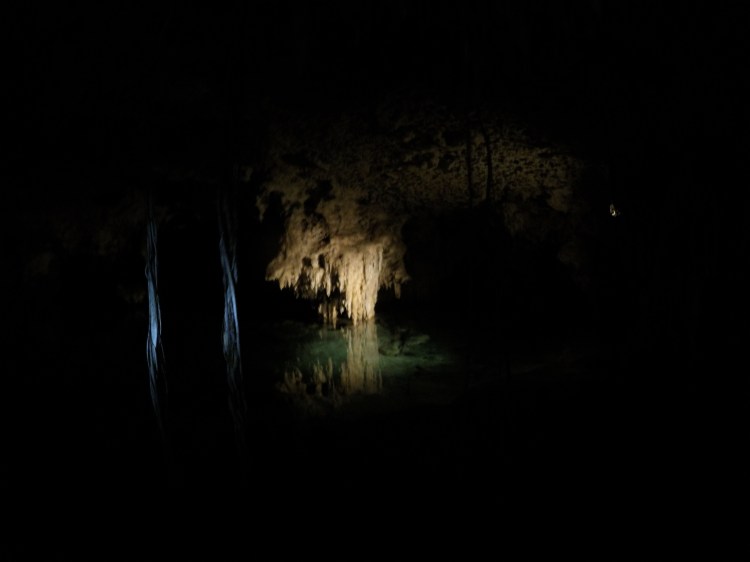
During the days, we visited the Tulum Ruins, went to the beach (which was pretty special again) and went to dry caves and an underground cenote. Fortunately for us, there was a Mexican staying at the hostel that was very well travelled, in Mexico especially, and the rest of the world too. One of his jobs involved taking people on tours, some of which were to Cenote Caracol. This was a 3km walk on a narrow dirt road through the jungle just outside Tulum. Due to it not being close to the town, it meant it was pretty quiet and we were in fact the only people inside the Cave and cenote whilst we were there. It helped having Victor, our Mexican friend. Through the jungle we were getting information about everything around us and were even told stories and Mayan folklore. He took us through the Cave system first, again giving us info on anything he saw. The whole of the land in this area is made from limestone, so apart from being really hard to grow food on, it meant the caves had beautiful stalagmites, stalactites and just incredible surface patterns.
After the cave was the cenote. You had to through a hole in the earth, down about 30 steep steps to get to the main body of water. The water was really clear but there was very little light in the cenote itself. Above our heads was the cave ceiling, littered with stalactites, bats and the only light inside was artificial and fairly sparse in most areas. Victor guided us through the cave system, squeezing through narrow passages and sometimes having to duck through tunnels where the water level was touching the roof. It was such an amazing sight that we could never had experienced if it wasn’t for Victor’s knowledge and guidance.
Having spent way too much recently, it was about time we did some volunteering. We needed to save some money by working 5hrs a day, for 5 days, and in return we would get accommodation, breakfast and lunch, and normally a chance to learn local cultures or use the places facilities. We applied to 3 different places and 2 got back to us within a few hours. One was in a Mayan village in the Jungle and the other was at a Hostel/Hotel in Bacalar. We decided to go to Bacalar, a small town next to a humongous piece of water, coloured beautifully in a variety of shades of blue and green.
Yet another place of paradise awaiting our arrival.


Loved your blogs Matt. The pics are amazing. Keep yourselves safe. Love Colleen and Dave. Xxx
LikeLike
Loving your adventuresMatt,enjoy yourselves.x
LikeLike